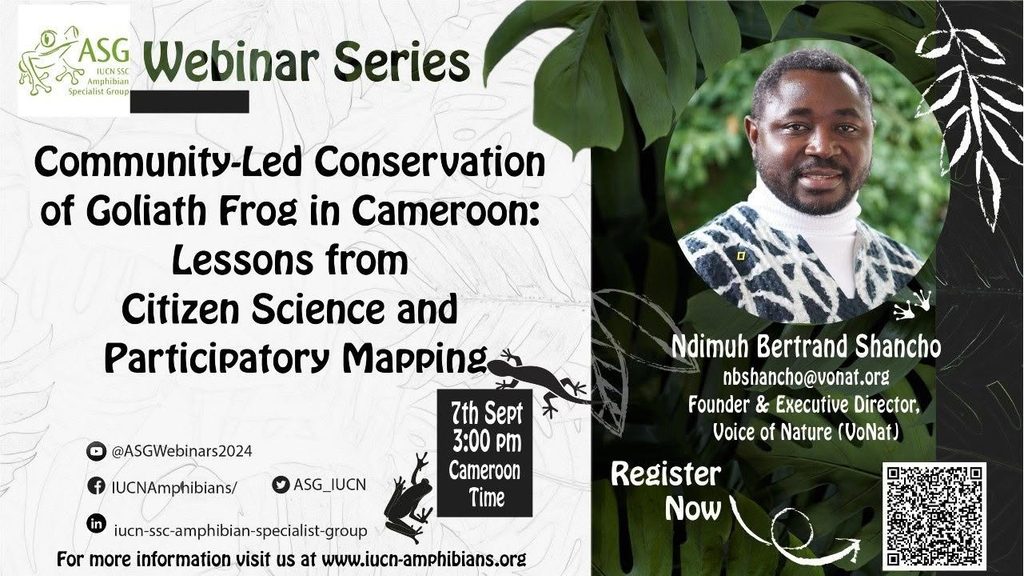
How can local communities become the heart of amphibian conservation? This question took centre stage during an international webinar of the IUCN SSC Amphibian Specialist Group (ASG) on 7 September 2026, as Voice of Nature (VoNat) Executive Director Ndimuh Bertrand Shancho shared lessons from Cameroon’s community-led efforts to conserve the world’s largest frog, the Goliath Frog (Conraua goliath).
Speaking during the IUCN ASG International Amphibian Webinar Series, Ndimuh presented “Community-Led Conservation of Goliath Frog in Cameroon: Lessons from Citizen Science and Participatory Mapping.” The session explored how local knowledge and community participation can complement scientific research and strengthen conservation action in landscapes where people and threatened amphibians share the same ecosystems.
Ndimuh emphasised the importance of recognising communities not simply as beneficiaries or sources of information, but as active partners in conservation. Through citizen science, local people can contribute to documenting biodiversity, identifying threats and monitoring changes in important habitats.
Participatory mapping offers another practical pathway for bringing local knowledge into conservation planning. Communities often have detailed knowledge of rivers, streams, forests, agricultural areas and other landscape features. Combining this knowledge with scientific information can help identify important habitats and areas facing increasing pressure.
The webinar provided an opportunity to share lessons from Cameroon with an international audience of amphibian conservation practitioners, researchers and enthusiasts.
As amphibians face growing pressures from habitat loss, environmental degradation, climate change and other threats, community-centred approaches can help connect scientific knowledge with realities on the ground.
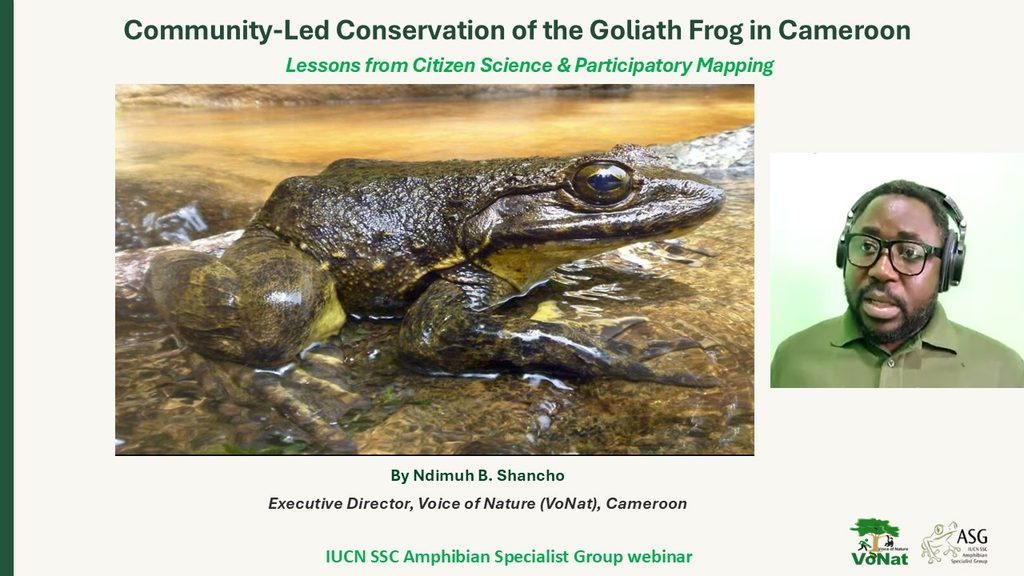
The Goliath Frog is an important symbol of Cameroon’s freshwater biodiversity. Protecting the species therefore also means safeguarding the rivers, forests and riparian habitats on which it depends.
Goliath Frog conservation has been a growing focus of VoNat’s work since 2021. The organisation has worked with communities and other stakeholders to better understand threats to the species and its habitats while promoting locally informed conservation approaches. This work has included engagement around important amphibian landscapes such as Mount Manengouba and the Nlonako landscape, where communities are closely connected to the forests, streams and other ecosystems supporting amphibian diversity.
For VoNat, the experience demonstrates that conservation cannot rely solely on protected-area designation or interventions led from outside local communities. Sustainable conservation also depends on the knowledge, participation and commitment of people who interact with these landscapes every day.