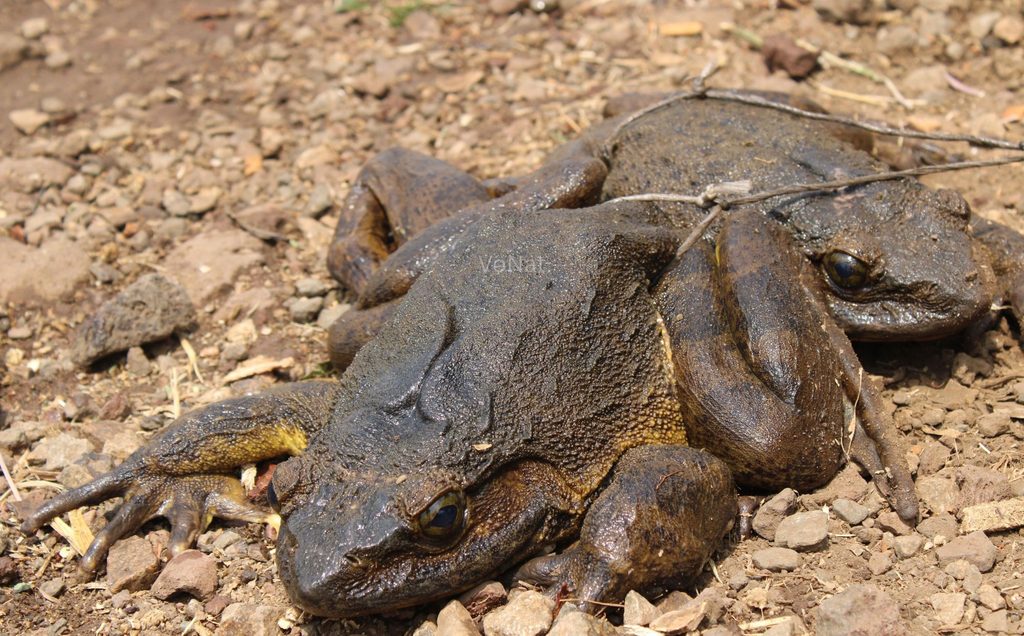
Born in the rushing waters of Cameroon’s forest rivers, the Goliath frog (Conraua goliath) is the world’s largest living frog. Yet, increasingly, some of these remarkable amphibians end up bound by ropes on dry land, destined for consumption or sale. For a hunter, each Goliath frog represents a few thousand francs to meet an immediate basic need. But for a species already facing pressure, every captured frog is one less giant in the wild.
Mr. Lakatouch, a local hunter, explained that Goliath frogs are an important source of meat for his household, while selling some helps him pay rent and meet other family needs.
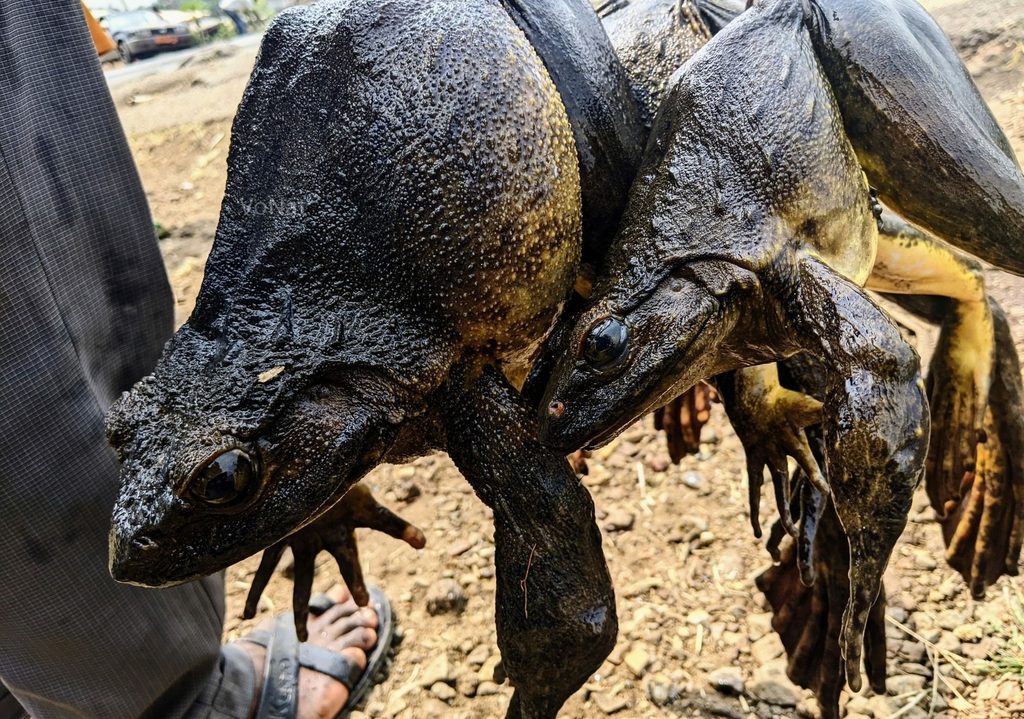
“If I have another means of survival or a lucrative business, I will not be risking myself at night hunting the frogs,” he said, adding that with alternative income, he could afford to buy fish or chicken instead.
The economic value of the trade can be significant. Hunter Emmanuel Njong reported that four live frogs could sell for between XAF 20,000 and XAF 50,000, depending on their size and the buyer, while four dead frogs could fetch around XAF 10,000. He also described consuming some of the largest frogs at home, highlighting the species’ role in local food practices.
According to Njong, hunters traditionally go out at night, particularly on Thursdays and Fridays, to capture frogs along their riverine habitats.
These accounts reveal the complex realities behind Goliath frog harvesting. For households facing economic pressures, the species can provide food and immediate cash. At the same time, continued removal of frogs from the wild, combined with habitat degradation, can place additional pressure on populations already facing conservation concerns.
Since 2021, Voice of Nature (VoNat) has been working with communities in important Goliath frog landscapes, including the Mount Nlonako and Mount Manengouba Key Biodiversity Areas, to better understand these challenges and develop locally led conservation solutions.
VoNat’s approach combines research, citizen science, environmental education, community engagement and participatory conservation, while recognizing that lasting protection must also take into account the livelihood needs of people living alongside the species.
The journey from rushing rivers to ropes is therefore more than a story about a threatened frog. It is a reminder that protecting Cameroon’s remaining Goliath frogs requires solutions that address both the ecological needs of the species and the realities of the communities whose lives are intertwined with its survival. Support us in saving Cameroon’s remaining Goliath frogs.
By Ndimuh Bertrand Shancho