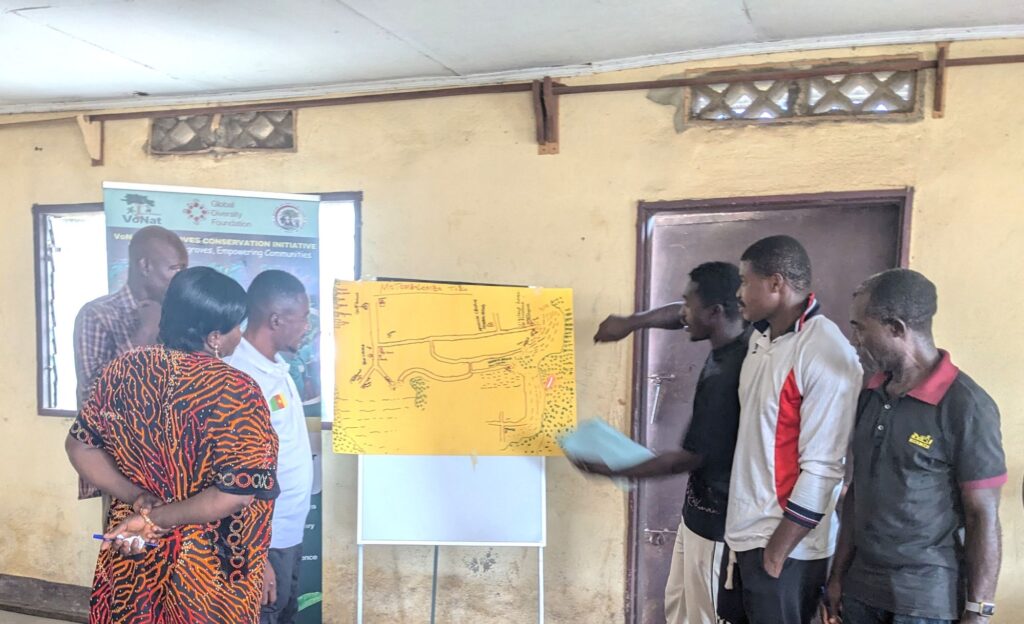
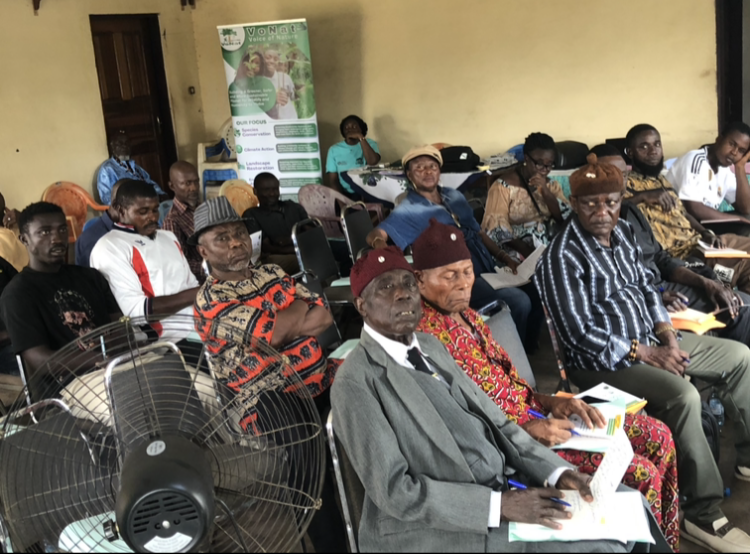
Voice of Nature (VoNat) has facilitated a participatory workshop bringing together over 30 traditional leaders, community members, and mangrove harvesters to identify local solutions for conserving the Tiko Mangroves. The session, which took place at the Motombolombo Traditional Council Hall, is part VoNat’s Mangroves Conservation Initiative supported by the Global Diversity Foundation (GDF) to strengthen community-led stewardship of mangrove ecosystems in Cameroon’s coastal zone.
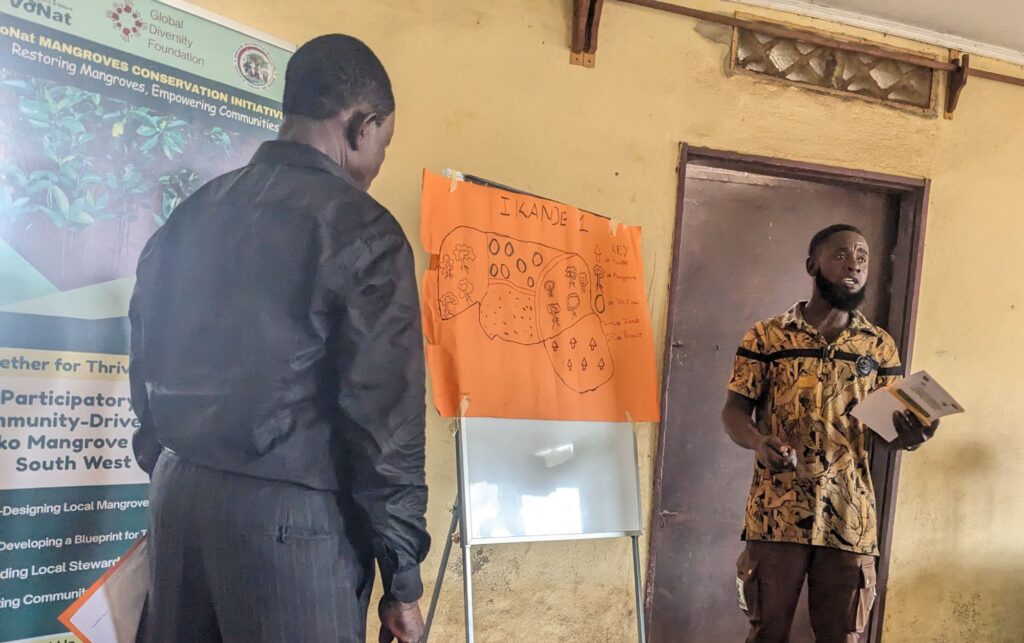
During the workshop, the VoNat team presented findings from recent grey-literature reviews and land-cover change mapping carried out between September and November 2025. The studies showed increasing pressures on the mangrove ecosystem, including overharvesting, land conversion, and climate-related impacts, trends that threaten biodiversity, fisheries, and the livelihoods that depend on them.
Participants shared firsthand accounts of how these changes are already affecting their daily life. “We are facing so much mangrove exploitation in an uncontrolled manner and we have seen the need to preserve it for the future generation. Even fishermen go far into the sea and come back with very little catch. Fish has become expensive, and we feel the need for conservation and restoration so fish nurseries can return. We plan to form groups to monitor conservation actions, restrict harvesting in some areas, and limit the number of harvesters each day,” said Lifambe Evele Daniel, Quarter Head of Motombolombo
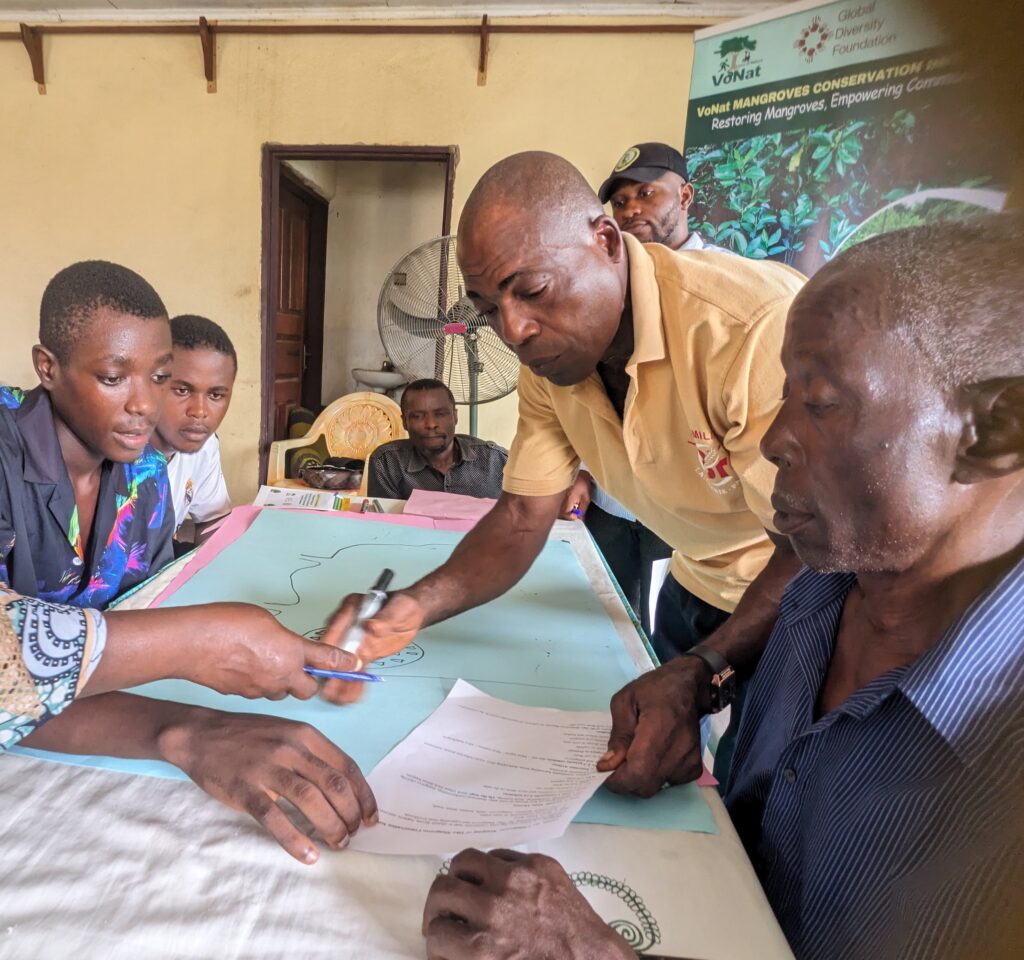
Through group discussions and mapping exercises, participants co-developed strategies to restore degraded mangrove patches, strengthen local monitoring, promote sustainable harvesting, and engage youth and women in stewardship initiatives.For many, the workshop helped clarify the link between mangrove loss and the increasing environmental risks facing coastal communities.
“It’s a very good idea, because if a problem is not well understood, a good solution cannot be arrived at. Through this workshop, we now understand the problem better, and with support we can work together to conserve our mangroves,” said Mr. Mbu John, Quarter Head of Ekanje I.
Others emphasized the social and safety consequences of unchecked mangrove destruction. “I have understood that overharvesting causes floods and allows strong sea winds to reach our homes because the windbreaks have been cut down. Roofs are blown away, and many fish species have disappeared. I feel good being part of the solutions to restore our ecosystem again,” Mme. Sylvie Enowbessem, Assistant Quarter Head of Motombolombo, noted.
VoNat facilitators highlighted that the voices and solutions emerging from communities will form the backbone of the forthcoming community-led conservation action plan, a roadmap that will guide the long-term and sustainable use of the Tiko Mangroves. By integrating local knowledge, scientific data, and shared decision-making, the initiative aims to ensure that conservation becomes both effective and community-owned, safeguarding mangroves that protect coastlines, support fisheries, and sustain livelihoods across the Tiko landscape.
By Ndimuh Bertrand Shancho